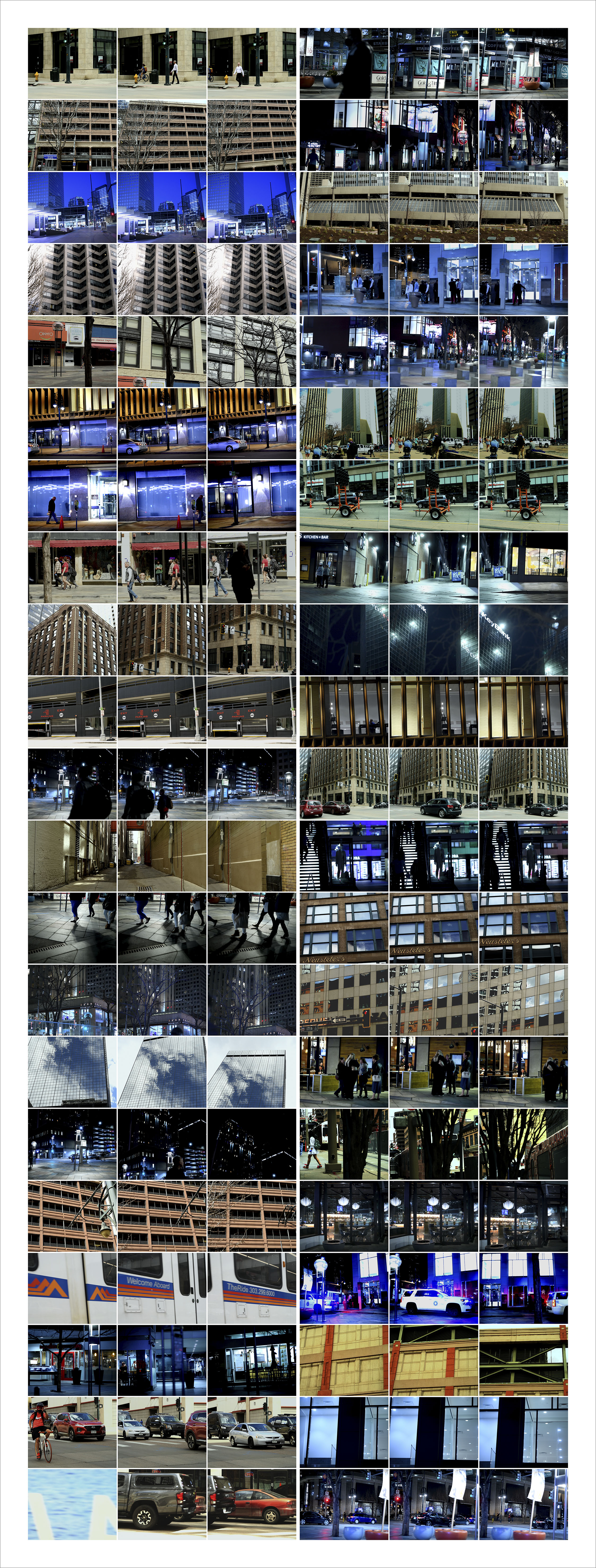

Early in 2023, after almost two decades of making digital prints based mostly on my own still photographs, I began making films again, digitally, about four decades after I ended work on my last film, which I have referred to for decades as SN but whose title, always meant to be Suicide Note, is being "restored" to it just as the film itself is being restored, and made available for public exhibitions, by the Chicago Film Society. There are prints drawn from the imagery of these new films which should succeed on their own, but will have their best effect when viewed in connection with the related film.
These films were shot in 4K video. Having seen them in full resolution on a large screen, I can say that what you can see from Vimeo on your computer is only a "reproduction," not the actual work. I am seeking public showings so that they can be seen as intended. At home, do view them on as large a screen as possible and in a darkened and quiet room; they are all silent. They absolutely will not survive on a phone screen, or a smaller tablet screen; I would prefer that in those formats they not be viewed at all. Each begins with eight seconds of black. This is not part of the work, but is there so that you have time to hide the cursor and the other distractions that are contributing to a flattening of all of our experiences. The title image and the four seconds of darkness that follow are part of the work, but the four seconds of darkness at the end are not. They are there to give you time to turn off the screen, so that the film ends when it ends, rather than serving to introduce whatever Vimeo is choosing to display at the moment.
I received some wonderful comments from a 20-year-old Brazilian whom I have never met, Pedro Accioly. They are so close to my own dearest intentions for these films — deepening the beauty and power of seeing ordinary things — that I am posting them here, though lower on this page there are links to other comments. Thank you, Pedro! "Your films truly make me see the structures, the architecture, the nature, the way the light hits on the plants, flowers and trees, the movements of cars and people, the colors of things in a very different way. It's such an incredible impact that no other filmmaker had made me feel (not even Ford, my favorite). So thank you very much for the work you've been doing. Your work, both critical and as a director, makes me hope for a better future." A friend of Pedro's, also a young Brazilian, responded to Pedro's comments when he read them, and I have placed his response at the top of my comments page.
If you're just starting with these, please read: I have noticed recently that many viewers begin with Interactions 1: Denver. Of course I am delighted if anyone wants to spend over four hours viewing these all in order, but even then I'd suggest it might be better to view some more than once. However, most seem to be just viewing the first few, which I consider the weakest, as I was still learning while making them. If you wish to view a few as a sample, please consider starting with some or all of Interactions 5: Netherlands Skies; Interactions 6: Amsterdam; Interactions 9: Stone Circle, Avebury; Interactions 10: Paolo Uccello's Hunt; and/or Interactions 13: Oradour-sur-Glane.
Interactions 1: Denver (2023), or film only. 5m
Interactions 2: Forest Near and Far (2023), or film only. 4m
Interactions 3: Forest and Stream (2023), or film only. 5m
Interactions 4: Questa, New Mexico (2023), or film only. 4m
Interactions 5: Netherlands Skies (2023), or film only. 4m
Interactions 6: Amsterdam (2023), or film only. 9m
Interactions 7: Near Antwerp Port (2023), or film only. 5m
Interactions 8: London (2023), or film only. 8m
Interactions 9: Stone Circle, Avebury (2023), or film only. 6m
Interactions 10: Paolo Uccello's Hunt (2023), or film only. 6m
Interactions 11: Jardins des Plantes (2023), or film only. 4m
Interactions 12: Both Sides of a Street (2023), or film only. 4m
Interactions 13: Oradour-sur-Glane (2024), or film only. 10m
Interactions 14: Bourges Cathedral (2024), or film only. 5m
Interactions 15: Ossining (2024), or film only. 5m
Interactions 16: New York City 1 (2024), or film only. 14m
Interactions 17: City and Suburb (2024), or film only. 5m
Interactions 18: Bloomington-Normal 1 (2024), or film only. 4m
Interactions 19: St. Louis Five (2024), or film only. 10m
Interactions 20: Views 1, St. Louis (2024), or film only. 4m
Interactions 21: Albuquerque (2024), or film only. 8m
Interactions 22: Bloomington-Normal 2 (2024), or film only. 13m
Interactions 23: Henry Hobson Richardson (2025), or film only. 5m
Interactions 24: Becky and Mike (2025), or film only. 3m
Interactions 25: Boston to New York (2025), or film only. 6m
Interactions 26: Hastings-on-Hudson (2025), or film only. 8m
Interactions 27: New York Brownstone (2025), or film only. 8m
Interactions 28: New York City 2 (2025), or film only. 14m
Interactions 29: Views 2, Athens (2025), or film only. 4m
Interactions 30: Archaeological Museum (2025), or film only. 15m
Interactions 31: Near the Acropolis (2025), or film only. 3m
Interactions 32: To the Temenos (2025), or film only. 11m
Interactions 33: Delphi (2025), or film only. 4m
Interactions 34: Vehicle Lights (2026), or film only. 9m
Interactions 35: Trinity Churchyard (2026), or film only. 5m
Interactions 36: Bridges (2026) 76m; only a three-minute excerpt is available for now.
An ESSAY ON INTERACTIONS, BY LIAM KENNY
COMMENTS FROM FRIENDS ON INTERACTIONS
STATEMENT 11: CONNECTEDNESS, EQUALITY, AND LOVE
I discovered fairly early in the past two decades, when I began completing art works, that I would initiate a new project with no idea of why I had started it or how to explain it. Then, after some months, my experiences as a writer on art and film began to allow me to articulate reasons and justifications. I consider, perhaps narcissistically, those delays to be signs of authenticity, indications that my “process” was generating ideas that do not readily translate into words. Consequently, when I began, after a hiatus of four decades, making films in 2023, I was not surprised that I had few, and only very partial, ideas of what I might say about them. That after three and a half years I now feel more fully able to write a statement gives me some satisfaction, albeit only a little compared to what I gain from making the films. While my dogma as an art viewer, which I have never found reason to doubt, insists that any process, including the most unlikely ones, can produce great work, I have found that my best ideas spring spontaneously from what feels like some inaccessible layer of consciousness. I might add that the organizational ideas that I apply to making films are themselves more than three decades old, originating in 1990 in the sudden appearance of an obviously unrealizable idea for a twelve-hour 35mm silent film to be shot all over the world and titled True Relations, but that my justifications for those methods, back then and today, don't provide much insight into what might, or might not, be of value in the work.
Three central principles inform my current filmmaking. Two sprang from a spiritual, nearly out-of-body experience a half-century ago during almost two weeks of hiking and camping alone in Northern Canada. That trip, in August of 1975, coming only a few months after my stepfather’s suicide, and at a time when my city, New York, almost went bankrupt, also followed ten earlier woods trips,
over a period of eight years, all but one of them to Maine, the first two involving (embarrassing to admit) a motorboat, a subsequent four being two-person canoe trips with three different friends in all, then also two trips kayaking alone, and two trips hiking alone. Even the most unpopulated areas of Maine are not wilderness: human signs, such as occasional cabins and unused logging roads, dot the landscape. Too many times, after hours of hiking through dense, cluttered, even damaged forests toward what I had concluded from maps would be an isolated lake, I would hear the ugly sounds of a motorboat well before seeing the lake, denying again my hope to briefly separate myself from a world badly overrun by the most invasive species in the history of our planet — us. I finally did find such solitude in areas of Canada completely off the North American road grid, south of the tree line but far enough north so that climbing a hill only a few hundred feet in height would take you from trees to tiny shrubs and then to lichen on otherwise bare stone, from which you could see many miles in every direction to other hills, valleys, rivers, and lakes. On the first of my five such trips, sitting atop one such rock, I thought of the tree-filled valley from which I had ascended, with smaller trees on the way up, even smaller plants a little further up, and finally cracks in the summit rock from which green shoots only an inch high were sprouting, while I touched the rock itself, a source of the soil that nourished the rest. I was instantly pulled out of practical and logical thinking, possessed instead with a feeling of an overwhelming wholeness, which conveyed an emotional rather than intellectual argument that all things, myself and other animals and birds and plants and rocks and waters and soil and air, traveled between themselves, nourished each other, were inextricably connected not just in practical terms but as if by an invisible stream flowing between them all. The scientifically defensible distinctions between plants and animals, animate and inanimate, living beings and rocks, were wrong to the point of being lies: the wind reaching my skin carries the bugs and seeds and moisture and dust that are part of what created everything else. I stood outside of my rational mind in the manner of the best visionary experiences, and felt more truly whole than at any prior moment in my life, with an awareness that soon became more than a solely emotional one but also included the objective knowledge that the rock that was being broken up before my eyes could ages later host plants, and together with them make more soil, just as rocks and living things and water created the soil in the valley below; that the rock itself came ultimately from materials that were much hotter a billion years ago on a more primitive Earth; that nearly every element on our planet was once created in, and dwelled within, burning stars, tying us also to a time far more ancient than our solar system's. A single word evokes all of this across space and time: connectedness.
It pains me to disrupt such thinking with the need to reference our deadly politics today, but as many others have observed, the demonstrably traitorous American president and his demonstrably traitorous supporters use hatred and lies to not only deny connections but also to divide us humans from each other, and just as horribly, in denying the ecological processes that now threaten future human life, seek to deny us understanding of our planet as well. The awareness of the past, including the distant past, just described should also foster connections to an imagined future, a future far beyond our own lifetimes that our actions today are helping, for better and for worse, to create.
My second principle, equality, has as one of its origins the founding documents of the United States, and in particular the statement, however personally flawed its author may have been (Are we not all personally flawed
? Certainly I am.), that all men are created equal.
But, in the spirit of Aldo Leopold's ethical sequence,
we must extend that idea further, even if not so far as to claim absolute equality between a poisonous snake and the human child that it threatens, to seek the principles by which everything on our planet can be valued. In truth, connectedness and equality are equivalents, but while lacking the language to prove this, I can hope that the compositions and editing of my own films, the way different images are linked, while frequently articulating contrasts and oppositions, also create a nearly seamless flow of surfaces, colors, and diverse objects.
My third principle, love, may not seem to logically follow from the first two. It is birthed, perhaps, when our parents first hold us. It lives today in our smiles, our jokes, our passions for the things we most care about; in the unspoken bonds that can be felt between close friends; in our seemingly trivial greetings and farewells; in the glances and smiles and hugs we exchange with each other; in the unspoken feelings during times spent with those we are close to in mutual engagements with the things we most care about; in the simple act of signing a letter love.
But it cannot, at least in my own eccentric view, exist only between humans and other humans, nor only between humans and animals. We must love the myriad shapes of clouds, of skies, of moving and still waters, of leaves and stones, of the stars, and of human constructions — not only in the beauties of the great buildings but also in the pleasures that can be found, if only in the close examinations of isolated parts, in the bad ones. One must love the way objects are drained of color and yet gain mystery in the advance of evening; the myriad movements of vehicles and people that both rhyme and clash in city scenes; the softness felt when caressing the skin of a beloved; the roughnesses of the surfaces of buildings, or sidewalks, or stones. In the end it is the impulse to love that gives us the ability to elude the hatreds that evildoers try to infect us with to gain control, thereby granting us the energy to go on living — and the ability to feel connections between every object in the world, past, present, and future.
I would like to think that behind my three principles lies a desire to embrace the whole world. Roberto Rossellini's Europe 51 is a key text. Irene, the protagonist, having lost her young son to suicide, engages in helping others in what is obviously understood as Christian love. She says that loving only those closest to us
is not enough,
and that we need to make our love bigger, until it embraces everyone.
Following Leopold, I would argue that we need to make it bigger still, to embrace animals, plants, rocks — all things on my lists and more, as in a favorite example, the weeds that grow out of cracks in concrete, and to feel, in the expansiveness that seems to be the only cure for today's rampaging individual selfishness, an extra-anthropocentric universal love.
Fred Camper
July 21, 2026.
Chicago, Illinois
PRELIMINARY STATEMENT OF NOVEMBER 2023
Interactions consists of two types of works. The first is a series of short films, thus far only silent. They may look best as projected films, with projected video a second choice, and video on a decently sized screen in a darkened room the third. They will likely not be visible as art when seen on a phone or a tiny tablet screen. There are ten Interactions films so far, with many more likely to come.
The second type is a group of works called Grids, of which there are three types, Grids 1, Grids 2, and Grids 3. There are, or will be, three for each film, one of each type. These are grids of still images taken from the films. Grids 1 uses one image from each take of the film; Grids 2 and Grids 3 use three from each take, generally meant to be read together in rows of three, top to bottom or left to right, and almost always presented in the order in which they occur in the film. The Grids can be viewed in any order, but there is a primary way intended, which is to view the images in the order in which they appear in the film. For Grids 1, that is how you would read a printed page. For Grids 2 that would mean viewing the columns of three images top to bottom, and the rows of them left to right, and for 3 the rows of three left to right, and then the columns top to bottom.
If I could write the shortest possible artist's statement for all my work, perhaps as a response to the unasked question, Can you sum up what you are trying to tell us in four words?
my answer would be, Look at the world.
I like to add, only half-jokingly, That is the meaning of my entire work. The rest is commentary.
There is, to be sure, a long history of art attempting to enrich, and elevate, eyesight, and not only in visual art.
Each work so far is shot entirely outdoors,
though I expect that to change, as our world also is found indoors. [Update as of July 21, 2025: It did change. See, for example, 24, 26, and 27.] Each contains no staged
images, though that may change too. Past cinema is one of my inspirations, and constructed fiction films can certainly address ways of seeing the world. The only special effects
I have used are modifications to brightness, contrast, and in a few cases color, and at least at present I don't expect that to change. Through framing and editing, I hope to help the viewer rediscover the life-giving beauties of sensuous, imaginative, and thoughtful seeing. My general intent is evoked in the poem Philarete Praises Poetry, by George Wither, written on or before 1621. I could easily claim these six lines as another version of my artist's statement of purpose. Please note that in context the her
referred to is Poetry
:
In my former dayes of blisse,
Her divine skill taught me this,
That from every thing I saw,
I could some invention draw:
And raise pleasure to her height,
Through the meanest objects sight.
With regard to the films, it might be most rewarding to view one of them three or four times rather than to view four of them once each. It is my hope that they will reveal more coherence, and perhaps even grow more wonderful, with greater familiarity. Note the rhythms of movement within shots, and between shots, and the rhythms produced by intercutting varying shot lengths. Note the matches, or mismatches, that occur at the point of each cut: a tiny movement in one part of an image continues to another part of the next; intercut shapes match but imperfectly, or else contrast. In addition to hoping to raise looking at even ordinary things to the pleasure
of poetry, I would hope my rhythms reflect inspirations from classical music. As well, I am influenced by the visionary, almost out-of-body sensations I experienced on wilderness trips, one of which is described above.
My original intention for the Grids was to show one or more of them in an installation hanging next to the monitor or screen that displays the film. That will be done in public showings wherever possible. I am unsure of how successfully they connect with the films when both are viewed online. One intention is that they will evoke the wonder, as I hope the films will as well, that can be found in viewing a plant in close-up, or an ordinary house, or a painting in a museum, or a bicyclist, or the sky. I would suggest one way of using them would be to view the images from a very few takes in connection with reseeing those takes in the film.
Each of the four types of works is meant to stand on its own. However, I hope they will also reinforce every other image, each having a kind of meta
relationship to the other. We know that any film is a succession of still images, and viewing the Grids with the film that generated them should reinforce that awareness, and, I hope, offer poetic qualities to their combinations as well. We know that still photographs can suggest movement, and I hope that will also occur here. In Grids 2 and Grids 3, the juxtaposing of three images taken in the same few seconds should suggest the changes in any scene over time. One might imagine the small rows and columns of three as suggesting a kind of cinema in miniature. Even the single images of Grids 1 should suggest movement in the ontext of the film. I have thus far shot only handheld, and I can be an extremely unsteady hand-holder, so every image will be a tiny bit different from every other. None are repeated; I carefully select seven different stills from each take to construct the Grids. The viewer may feel a bit at sea at first, understanding that movements suggest stills and that stills suggest movements. I hope what emerges is a sense that the truth of the visible world is perceived in a greater fullness, lifefulness, and glorious uncertainty, through an awareness of both.
Fred Camper
Chicago, Illinois
November 24, 2023, Revised January 17, 2024.